
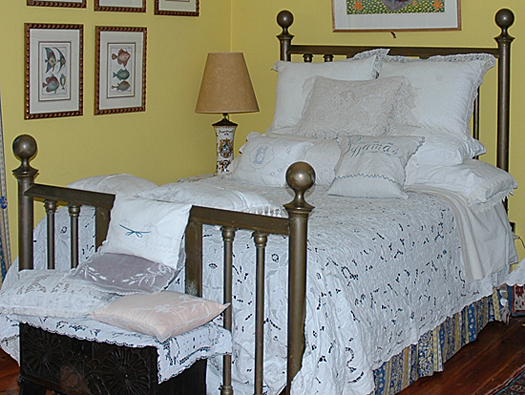

In better quality late Victorian and Edwardian bedrooms, grand old wardrobes and dressing tables were flanked by fancy chairs and perhaps a small side table. At each side of the double bed would be small matching cabinets. Very important for those times was a place to hide the chamberpot. The essential toilet set of jug and basin, toothbrush holders and soap dish stood on the specially designed washstand with its marble top and tiled back. Plain white sets were fine for men’s or children’s rooms but in fashionable schemes or those a little above the ordinary were the wonderful decorated sets.

Dressing tables and combination chests had small drawers to hold many of the essential feminine items, while other items were carefully displayed in their appropriate places. Porcelain trays complete with ring trees, powder jar, candlestick, pill-box and hairpin holder were suitably decorated and in turn placed on a piece of decorative needlework. Silver-mounted mirror, brush and comb sets were popular for a long period, and from the 1890s an early form of plastic known as Xylonite was used for these and for combs, buttonhook handles, hairpin trays, hair tidys and shoe horns. With long hair as a universal fashion, women sat at their dressing tables for twenty minutes each evening carefully brushing their locks before retiring to bed. Any stray hairs were carefully rolled up and popped into the hair tidy, a round or oval box with a special hole in the top.
Preparing the bed meant removing the pillow shams and bolster, each usually embroidered and decorated with borders of crochet work. The quilt might be of plush or wool and in some instances patchwork. This was the era when so many things were “dressed up”. Flat surfaces had runners and mats or doilies and other furnishing and shelves were draped with valances. Applique runners were used on duchess chests and dressing tables.
While women kept their jewellery in a casket on the dressing table, the men were likely to place their essential collar studs, cuff-links, tie-pins and alberts in a stud box in the top drawer of the bedside cabinet or set to one side of the washstand.
Whether it took place in the bathroom, bedroom or other convenient spot, the ritual of shaving had its special kit. In the earlier times there were tall stands with round, wood-framed mirrors. By 1900 a stand was made for a table-top and had a holder for the mug, a double-sided mirror, a clip for the brush and another holder for the shaving stick. The razor strops for sharpening the blades are perhaps the most memorable item. Anyone beyond a certain age will remember that the razor strops were a real threat to the young miscreants.

As to bathing, it all depended on the season and the house. Houses with bathrooms might have the luxury of hot and cold running water, others just had a bath or tub and water was carted from the kitchen or the copper. Bathing was a Friday night ritual in those times. Gas hot-water heaters and the old chip heaters made baths a little easier.
For the chill nights there were hot-water bottles made of stoneware with screw-tight lids, and for others the old trick of a hot brick wrapped in a flannel took that first chill off the bed sheets.


