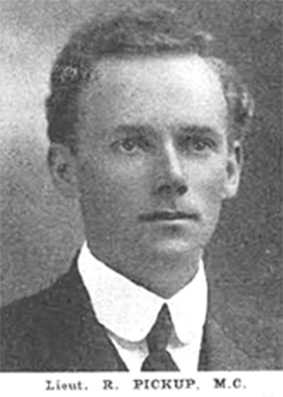
Rev. Robert Samuel McKee Pickup, MC, ED
Robert Pickup was born in Auburn on 30 December 1888. His early education was at Auburn Public School and thereafter at Baptist College in Parkville Victoria. He graduated from there in 1914 and was ordained into the ministry. When war broke out, Robert returned to Sydney where he enlisted as a private in the AIF in August 1915.
He soon won promotion and at the end of his basic training was allowed to retain his temporary rank as sergeant during the voyage to Egypt. After the Gallipoli campaign it was decided to double the size of the AIF by mixing new recruits with experienced soldiers to form additional battalions. The 45th Battalion, to which Pickup was assigned, was one of those formed by this means. This was to become an important factor in developing the resilience and fighting spirit the men would need, as they were almost immediately thrust into the front line on the Western Front.
Sergeant Pickup continued to show leadership qualities and was sent to England to undertake officer training. He returned to his unit in early 1917. His appointment as lieutenant, however, was delayed by bouts of pleurisy and a period in hospital and convalescing. When he was able to return to the front he was wounded in action and suffered a fractured rib. Nevertheless, he carried on as the war entered its most dangerous phase. With the capitulation of the Imperial Russian Army the Bolshevik Government withdrew from the war. The relieved German forces were rushed to the Western Front and unleashed a final attempt to break Allied lines in what became known as the Spring Offensive.
Between March and May 1918, the Australian Divisions were used as shock troops to blunt the German assault and counter-attack where possible along the Hindenburg Line. While subject to the most intense artillery bombardment, it was critical for the Australians to hold their positions. In this situation, Lieutenant Pickup was awarded the Military Cross for his courage and quick thinking in preventing German forces breaching Australian lines.
His citation states his award was: “For conspicuous gallantry and devotion to duty when the enemy by a heavy barrage on an isolated part caused many casualties, this officer crossed the open to the post and restored order and confidence returning under heavy fire to his own trench”.
The Military Cross (before 1993) was awarded for “an act or acts of exemplary gallantry during active operations against the enemy on land”. It was ranked third, after the Victoria Cross and the Distinguished Service Order. Although Pickup had not enlisted as an army chaplain, it was unusual, to say the least, for an ordained minister to be the recipient of a Military Cross, since it must be won in actual combat with a present enemy.
Pickup ended the war with the temporary rank of Captain. He returned to the ministry in 1919 as pastor of Concord Baptist Church, a position he held until 1929. During World War II he served as Deputy Assistant Chaplin General, 2nd Aust Corps. 1943-1945. He died in October 1961 and was buried at Rookwood Cemetery. Rev. Pickup is remembered on the Roll of Honour in Concord Baptist Church in Carrington Street.
Andrew West