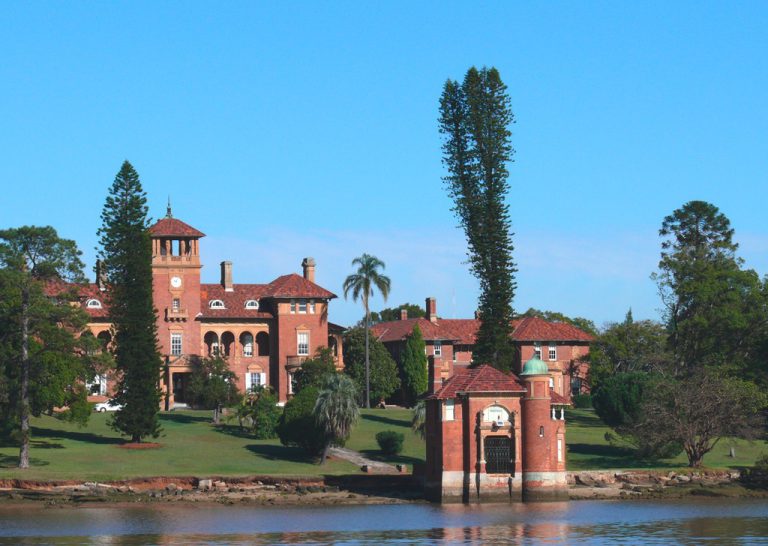
Cabarita Point was first named in the 1856 Survey Map. At the time there was a property known as “Cabarita House” near Kendall Bay. It is not clear whether the location took its name from the house or if the house was named for its location.
Cabarita is presumed to have derived from a local aboriginal name for the area meaning “by the water”. However, this is unsupported by documentary evidence and is not recognised by the present-day custodians of the Wangal language. There are other places in Australia that share the name Cabarita, but are unrelated to local indigenous culture. These include: Cabarita Beach in northern NSW, the suburb of Cabarita in Mildura, Victoria, and “The Cabarita Resort” on Stradbroke Island, Queensland. There is also a Cabarita Island and the Cabarita River in Jamaica.
A more likely scenario is that the name is a reference to the Cabarita region in Northern Spain where Surveyor General, Major Thomas Mitchell served in the Peninsula War. During this campaign Mitchell was tasked with surveying an area close to where British troops were camped.
Early land grants did not refer to Cabarita, but described the allotments as being close to Hen and Chicken rocks, a notation that appears on sketched maps of the Parramatta River drawn by Lt. William Brady, who with Captain John Hunter undertook the first exploration of the Parramatta River in February 1788.
The first land grants were offered to non-commissioned officers of the NSW Corps on condition that they occupied the land and carried out improvements such as clearing the land for farming or erecting buildings and fences. For the most part the grants were forfeited or sold to investors who consolidated them into larger holdings.
John Ward was one such investor who owned most of the area now known as Cabarita. On his death his estate passed to his adopted son Alexander McDonald.

In 1883 the Australian Gas Light Company purchased 32 hectares at Kendall Bay and established a large gasworks plant on the site. This created a need for houses, shops, schools and places of worship nearby, giving rise to the growing township of Mortlake.
McDonald subdivided his land into portions that were auctioned in separate lots between 1886 and 1909. They were advertised as the McDonald, Riverview and Singlewell Estates. MacDonald retained an area between France and Exile Bays where he built Collingwood House. The property was acquired by orchardist William Cox and on his passing the estate was subdivided. Collingwood House was demolished to create a street of the same name and allow access to more housing blocks. (Andrew West)