Post WWI were boom years for building suburban houses that were detached and provided a yard for relaxation and family pursuits.
The popular style was the Californian bungalow, a style readily adopted into Australia from the USA from 1913 onwards. They provided an excellent standard of accommodation within a single storey and incorporated a verandah beneath a gabled roof.
An important change which was to have lasting ramifications came to Concord in the time between the end of World War I and the onset of World War II. It was during this period that many of the old landed estates were subdivided and sold for building blocks.
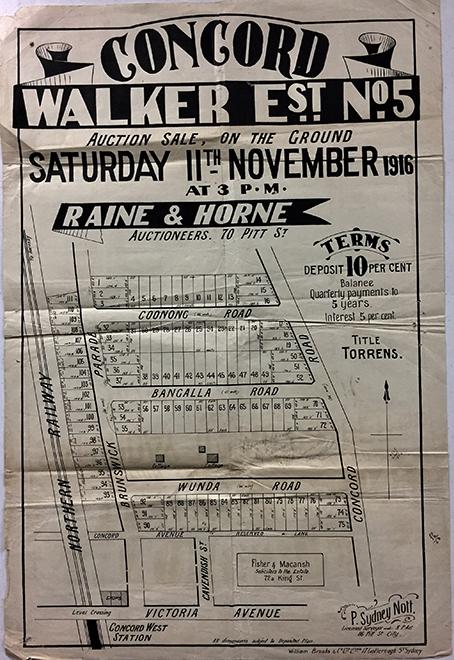
Most significant was the subdivision of the greater part of the Walker estate which encompassed much of present day North Strathfield and Concord West. However, scattered around the municipality were many other parcels of land, large and small, which were also opened up for development.
The main factors responsible for Concord’s rapid recovery from the depression was the improvement in transport services, roads, sewerage and drainage facilities, due to work carried out by relief workers and government allocations of finance for public works.
Industrial expansion on Hen & Chicken Bay and Homebush Bay-West Concord area enhanced the prospects for local employment which encouraged more builders to the area.
By 1920 Concord was ready for subdivision and development. The ferry service still existed and the public transport system provided adequate service by rail and tram. The motor car was becoming increasingly common. Concord’s earlier isolation and particularly the large amount of its land that had been tied up in the Walker estate, meant that extensive tracts were still available for development.
Moreover, by 1920 home ownership had become more accessible than ever before to those of modest means.
The Commonwealth War Service Home Commission, formed in 1918 to repay society’s debt to its servicemen and overcome the desperate shortage of housing after World War I, built homes for ex-servicemen who wanted to achieve the Australian dream of a family home set on a suburban block of land.

These houses were built in 1925 by John Hood at the corner of Lyons Road West and Scott Street, Five Dock. John Hood is standing at the front gate of the second house. Hood was born in Ayrshire, Scotland in 1884, arrived in Australia in 1912 and died in 1937. He was a builder and served as an Alderman on Drummoyne Council 1922-1925.