For almost two decades the Mornington Hotel, situated where Emily and Herbert Streets now join Tennyson Road, was a hub of community activity in Mortlake. The hotel was not only a popular place of refreshment for workers from the nearby gasworks, it also played host to sporting groups such as the Mortlake Swimming Club as well as being the venue of choice for political meetings and even coronial inquiries.
The two-storey weatherboard building with its balcony overlooking Tennyson Road provided a ready-made platform from which speakers of all political persuasions could address those gathered below. During the 1895 election campaign, New South Wales Premier, George Reid, addressed an enthusiastic crowd of supporters from this vantage point. Reid spoke in support of Free Trade candidate, William McMillan, the Member for Burwood, whom he said had been a strong supporter of the Government and liberalism. The same platform was used at other times by trade unionists advocating worker’s rights, while in 1893 the hotel hosted a well-attended meeting that sought to reorganise the Mortlake Branch of the Australian Labor Party.
The Mornington Hotel operated between 1893 and 1911. It occupied a 2-acre site that included a number of outbuildings and an enclosed yard. At that time Emily Street was not cut through to Tennyson Road and there were only a few houses scattered nearby.
When a fire mysteriously burned down an unoccupied weatherboard cottage in Herbert Street in July 1894 – the resulting coronial inquiry was conducted in the Mornington Hotel. Despite strong evidence of arson, the presiding Parramatta Deputy Coroner was unable to identify who might have been responsible.
Other inquests conducted at the hotel included the apparent suicide of dentist Frederick Pierce in October 1907, who was found deceased on a patch of vacant land at Cabarita with a bullet in his head. Another inquiry was held at the Mornington Hotel when a recently arrived Irishman died of heat exhaustion after a day’s work at the nearby gasworks. The man entered the hotel bar in a distressed state and called for a brandy. While in the process of paying for his drink, he collapsed and could not be revived.
The Mornington Hotel had a strong association with local sports. Licensee and local alderman, Arthur T. Gale was captain of the Mortlake Swimming Club. The Club met at the hotel where it celebrated some notable achievements including winning the 220 yard freestyle race in a record time at the 1894 New Zealand Inter-Colonial Swimming Carnival. George Priddle, also a licensee of the Mornington Hotel, (1905-1911) was an Australian champion sculler who on many occasions rowed against World Champion, William Beach. His son Archie Priddle, was twice NSW champion and rowed against the Canadian champion, Bobby Pearce and New Zealand’s Paddy Hannan.
The Mornington Hotel closed in 1911 following a ruling of the NSW Special Licensing Court, which determined that the number of places where alcohol could be bought should be limited by community concerns. This was known as the “local option”. As a result more than 10 hotels within the Burwood electorate were closed, including the Mornington Hotel.
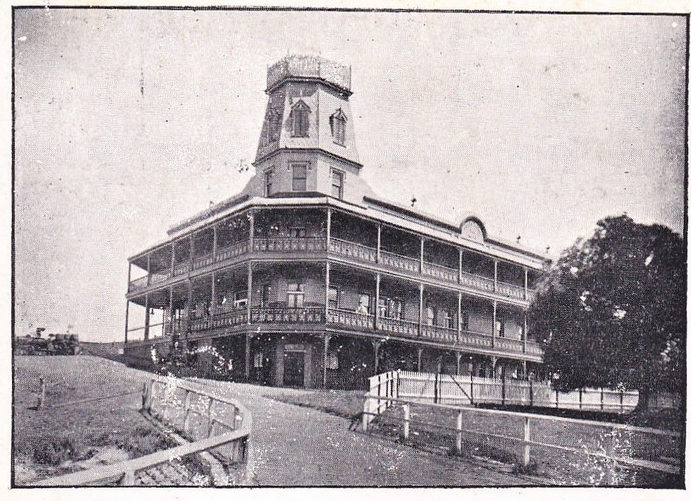
Mortlake’s remaining hotel was the Palace Hotel at the lower end of Tennyson Street – an imposing and quite grand Victorian structure commanding a view of the Parramatta River from which a “better class” of patrons might watch the regular regattas and sculling contests, away from the tens of thousands of other folk who crowded the shores. In the mid 1920’s the old Palace Hotel was demolished and replaced with a newer building, with the same name, almost opposite the main gasworks gates.
(Note: Unfortunately we have not been able to find a photograph of the Mornington Hotel so have substituted on of the Palace Hotel mentioned above.)
Andrew West