

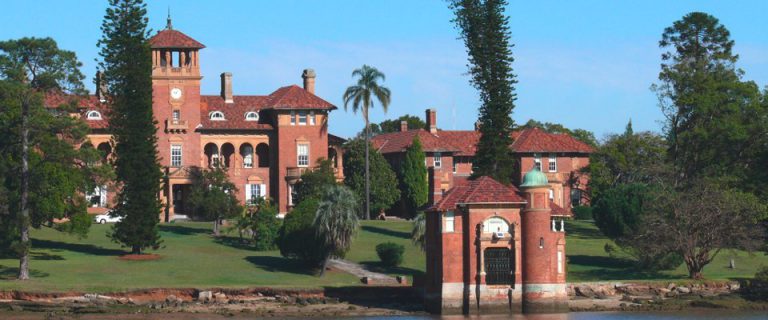
Following the death of Alfred Llewellyn Bray, the first Mayor of Concord, his home “Braygrove” was purchased by R. Tulloch & Company and in 1915 the Iron Works transferred from its original site at Pyrmont to Rhodes.

“Braygrove” was incorporated into the Tulloch administrative complex but fell into disrepair and was finally completely demolished in the late 1970s. Only the replicas of the original gates to the property now stand on Concord Road as a reminder of what was once a grand nineteenth century estate. The original home was considered to be the oldest home in Concord.
The founder of the company, Robert Tulloch (1851-1928), was born in the Orkney Islands north of Scotland. After working with a local blacksmith, he was apprenticed to the engineering trade and worked in Glasgow and London before migrating to Sydney in 1877.
In 1888 Tulloch’s firm received its first large contract, the manufacture of the overhead ironwork which supported the roof of the Eveleigh Railway Workshops. The company flourished and won several important contracts, particularly for the construction of railway bridges, viaducts and rolling stock.
In 1923 the company began manufacturing shovels, spades, garden tools, etc. under the “Tulloch-Phoenix” brand.
A memorial lamp post was erected in memory of Robert Tulloch in 1945 by members of his family. It stands in the Churchill Tucker Reserve opposite Rhodes Railway Station.
The large fig tree standing in the corner of this park is known as the “Strike Tree” as this is where the workers gathered to discuss the situation any time there was a strike at the factory.
The business closed in 1974. More recently this was the site of Digital.
Of the past, only Braygrove’s replica gate posts remain, standing on Concord Road.


Hi just found a old shovel in the shed it says it that band pat n2 151268 date 17-9-51 down below that it has a 1 stamped on it.
They were manufactured by Tullochs in their early days. We’d be happy to take them as a donation.
Likewise I have come across a 1951 Tulloch Phoenix shovel No 4 in Western Australia. Handle is also in good condition. considering age. Is this of interest to anyone?
Found a #2 shovel head stamped with company name of Tulloch Phoenix,also a # 5, without the name?.Presume it is not their own brand. Rescued both from scrap heap