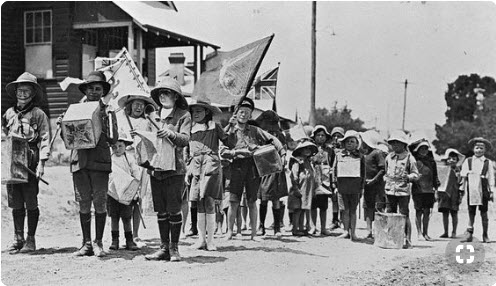
After more than four terrible years of war rumours of Germany’s wish for a peace treaty swept the world during October and early November 1918. An armistice – a truce pending an official treaty – was finally signed on Monday, 11 November, 1918 and the guns fell silent. Official notification of the armistice was received in Australia that evening and, despite the late hour, Sydney went wild. Enormous crowds converged on the city and those who could not board the packed trains and trams celebrated through the night in their local neighbourhoods.
Tuesday 12th was declared a public holiday and celebratory activities were held in community halls, parks and other places throughout the city and suburbs and in country towns. Wednesday 13th saw a parade through the city and 200,000 excited people packed the Domain for an official celebration, and many churches held thanksgiving services. In the evening there were fireworks and a chain of bonfires around the Harbour and in many suburbs. The formal peace treaty would not be signed for some months, but “the war to end all wars” was over. The consequences would last for decades and, in some ways, are still with us.
Approximately 160,000 Australians had been wounded, some of them permanently incapacitated. They would need to be restored to health and those unable to resume their former occupation must be re-trained and supported. Many needed assistance for the rest of their lives.
Some 61,500 Australians were killed on the battlefield or died from their wounds. With no graves to visit, their families found solace in being able to see their names on memorials where they could leave flowers or wreaths in remembrance. A war memorial movement quickly took hold, and almost every suburb or town, and many churches, workplaces, sporting clubs and so on honoured their dead in some appropriate and permanent way. A century later many of these proud memorials are in need of care and restoration.
Join us at the City of Canada Bay Museum on Saturday, 2nd February at 2:00 pm. when Dr. Neil Radford, will tell us more about what came after the end of the “war to end all wars”. Dr. Radford was the University Librarian of the University of Sydney 1980-1996 and, since 2012, has been a volunteer with the Dictionary of Sydney researching and contributing entries and assisting with editorial work.