The image, from a postcard dating to the first 10 years of the 20th century, is an evocative glimpse into a business that has long been linked to Martin Place (then Moore Street).
Martin Place had long been a bustling hive of activity, full of people going about their daily work. This bustling activity made it a perfect place for flower sellers to ply their trade, attracting passersby and many impulse sales. Yet most flower sellers did not start off in Martin Place at all, being forced off other, busier streets to make room for ever increasing traffic. Martin Place was the ideal place for flower sellers to congregate though, setting themselves up near the steps of the General Post Office and pouncing on people hurrying to mail their letters.
The earliest Martin Place flower sellers began to set up stalls in the 19th century, but it was during the 20th century that Sydney’s most iconic flower seller plied her trade. Rosie Shaw had once had high hopes of a career in opera, coming to Sydney from London in 1927 to seek fame and fortune in the land Dame Nellie Melba had called home. Rosie’s dreams never came to pass, but she grew to the status of a Sydney icon none the less. In 1931 she first set up shop on Martin Place, plying her customers not just with flowers, but with snatches of opera and tall tales of her history of a ballerina and singer. Rosie soon became very popular and increasingly influential, using her iconic status to act as one of the earliest defenders of gay men in Sydney. She sold flowers for 40 years, finally packing up her stall in 1971.
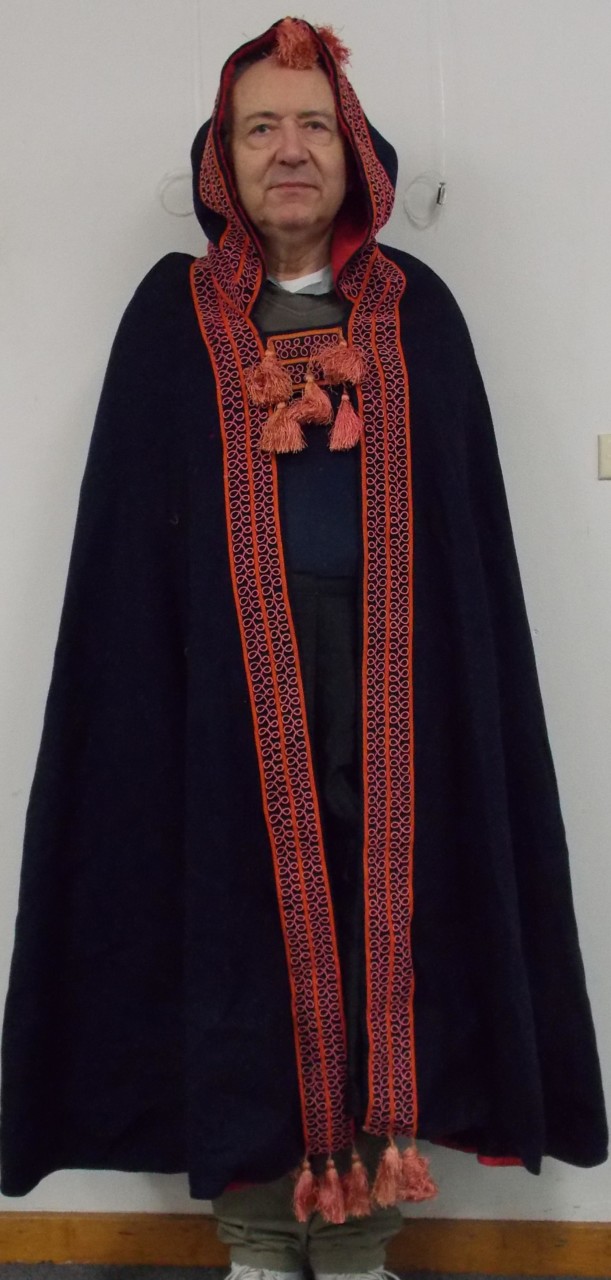
Found in our collection was this stunning outfit. Unfortunately we don’t know anything about it. The only clue we have is an attached piece of paper saying it was an ‘Italian Judge’s Cloak, WWII’. Can you help? Special thanks to our wonderful model, Patricio, who also helps out as our brilliant clever handyman.
When this book was originally published in 1979, mental illness was a closed book to the general public. It is not surprising that in the climate of widespread ignorance, mental illness was a taboo subject. It was rarely mentioned in the media, useful information and professional help was hard to find and so it was…
How would you feel if you were told that you do not exist? Owing to a razor left behind at a gruesome crime scene being identified as his property, Private Donald Miller, of the 19th Battalion, fought for four years —fighting through asylums and convalescent homes— to prove that he was alive. One morning, a…
In October 1918 the Australian Army Corps in France broke the supposedly impregnable Hindenburg Line, carrying the neighbouring armies eastward with it in the last great counteroffensive of the war. In the preceding seven months it had taken 29,144 German prisoners and 338 guns, and had recaptured 116 towns and villages. For the first time…
On 1 November 1666 farm worker Abraham Morten gasped his final breath – the last of 260 people to die from bubonic plague in the remote Derbyshire village of Eyam. Their fate had been sealed four months earlier when the entire village made the remarkable decision to quarantine itself in an heroic attempt to halt…
On 11 December 1920, the town clerk of the Municipality of Concord wrote to the Board of Fire Commissioners of New South Wales requesting assistance to form a local voluntary fire brigade. Town Clerk, H. A. Furness, stated that: “At last meeting of the Council of this Municipality I was directed to ask you that…
Add your first comment to this post
×
Nurungi Printed Copy
Do not print this page until after the first of the new month
This window will automatically close after 10 seconds