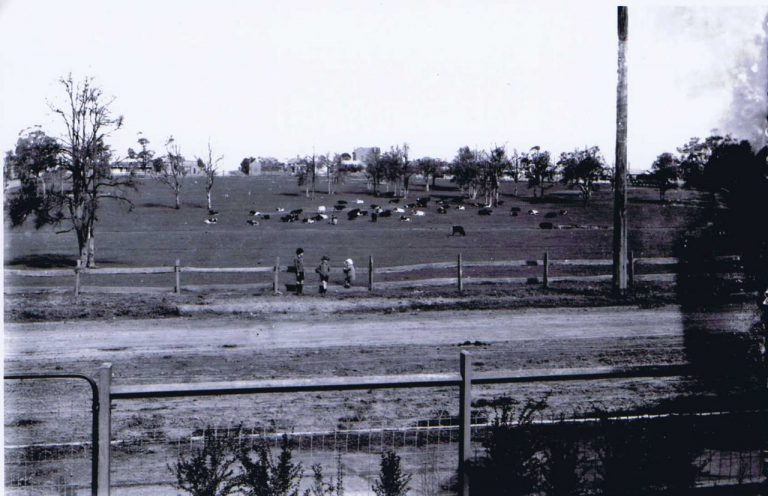
Walk down almost any road in suburban Concord and you will most likely come across a vacant lot or building site, where once there stood a neat Californian-style bungalow. These houses were ubiquitous throughout Concord and many other areas around Sydney. Built in the period between the wars when the district’s large estates and farms were subdivided for housing and industry, the Californian bungalow came to define Concord and more generally the Australian Dream.
Pause for a moment and recall what was there. Do you remember if the house had short columns on the front veranda – perhaps they were enclosed in the fifties when there was a need for extra space as migration and baby boomers brought a sharp rise in the population? There might have been coloured glass panes in the mullioned windows at the front or in the sidelights at the entrance door. Perhaps the original “eyebrows” or window hoods remained to shield inside the house from the harsh Australian sun. Sometimes the window panels at the end of the veranda afforded an opportunity to include a leaded window that referenced Federation themes or art-deco motifs. Above the front door was often a fanlight on which the name of the house featured in stained glass or even gold leaf.
Some might say, the Californian bungalows all looked the same, and it is true there was a uniformity in their appearance, particularly when they were built in pairs or rows as developers often did; but look closer and you will see there were subtle differences that gave each house a personality.
It is not easy to remember what a house looked like once it is demolished. Its previous existence contributed both to the physical streetscape as well as the “feel” of the area. We struggle to reconcile a vague recollection of what was there with what we now see. Our minds override past impressions to come to terms with the reality of the present.
It is not just the loss of the humble cottage where we experience this void. Canada Bay once had a number of splendid houses which have been lost to development and changing circumstances. Some are well known, such as Russell Lea, whose name became that of the locality it once graced. Others such as “Lyriclea” in nearby Lyons Road, have been largely forgotten.

“Lyriclea” was the home of pioneer pastoralist and property developer, David Ramsay. Ramsay’s extensive land holdings in Five Dock and Haberfield, included Dobroyd Farm, a wedding gift from his father-in-law, the wealthy emancipist merchant, Simeon Lord. Ramsay and his family of nine children lived in “Lyriclea” from 1879-1904. Lyriclea was surrounded by 15 acres of land, with orchards, a carpenter’s shop, stables and a barn. It had 14 rooms, servants’ rooms, a kitchen and two bathrooms.
When Ramsay died in 1901 his widow, Kate Dorothy De Mestre, sold the house and estate to Sydney Merchant William Smilie Tait in September 1906.

Tait lived there until his death in 1923 and the house was demolished shortly after. There remains little if any trace of what had once been. The view from the back veranda shows open fields sweeping down to the Parramatta River. It is difficult to imagine what “Lyriclea” was like then. It is still difficult to pronounce – hard to say what was there once!
- There are several spellings of Lyriclea /Liryclea found in the records I have used the one inscribed on the front gates.
Andrew West