In 1910 Henry Lawson wrote the following lines celebrating Sydney’s restorative Southerly Buster;
‘Tis a glorious mission, Old Sydney’s Physician
Broom, Bucket and Cloth of the East,
‘Tis a breeze and a sprayer that answers our prayer,
And it’s free to the greatest and least.
Often down on his luck, Lawson identified with the city’s urban poor; those who benefited most from a cool, southerly change. In the heat of summer, the wealthy escaped to the Blue Mountains or sought refuge in the shady grounds of their waterfront properties, while the disadvantaged sweltered in inner-city slums. They greeted the arrival of a Southerly Buster with relief, and could not have cared less if the storm scuppered a few rich men’s yachts in the harbour.
Lawson’s ‘Sydney Physician’ made house calls in the tenements of Darlinghurst and Surry Hills with a bedside manner every bit as gentle as the West’s Freemantle Doctor;
Oh softly he plays through the city’s hot ways
To the beds where they’re calling ‘Come quick!’
He is gentle and mild round the feverish child,
And he cools the hot brow of the sick.
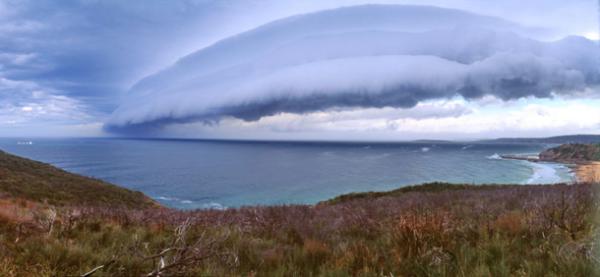
The arrival of a Southerly Buster is notoriously difficult to predict, though meteorologists now have the benefit of satellite imagery and weather-watch radar. At the time of WW1, staff at the Sydney Observatory coped with far less sophisticated equipment. It was the custom to warn residents of an approaching storm by hanging a red light on the GPO tower, though according to Henry Lawson the forecasts were not always accurate. His 1914 poem ‘Old Southerly Buster Gets Lost’ was inspired by the non-arrival of a predicted southerly change.
Oh have you not heard –
And the thing seems absurd,
Though the citizens knew to their cost –
As they dragged through the street
In the sweltering heat –
That old Southerly Buster was lost!
Oh! We stared for an hour
At the Post Office tower,
Where the red lamp was plainly in view:
Where it hangs from the rope
Like a signal of hope
When old Southerly Buster is due.
Until WWII, there was another signal that a Buster was on its way. A flag was flown at Observatory Hill with the letters JB printed in white on a blue background. The letters indicated that a southerly blow had reached Jervis Bay.
During the earliest days of the colony, Sydney’s summer storms were accompanied by billowing red dust from the settlement’s open brickworks. In 1850, colonial artist Frederick Garling captured the image of a southerly or ‘brickfielder’ sweeping across Sydney Harbour. His evocative watercolour depicts small craft being tossed under a dusky pink sky. And several years later visiting British journalist Frank Fowler wrote an equally vivid account of the strong, dust-laden wind;
‘A cloud of dust…they call it, in Sydney, a ‘ brickfielder’…thicker than any London fog, heralds its approach, and moves like a compact wall across the country. In a minute the temperature will sink fifty or sixty degrees, and so keenly does the sudden change affect the system, that hot toddy takes the place of the sherry cobbler, and your greatcoat is buttoned tightly around you until a fire can be lighted. ’
In 1879 George Herbert Gibson, who wrote humorous verse under the pen-name ‘Ironbark’, published a book called Southerly Busters. Its cover of gilt-stamped blue cloth shows seven sets of bellows blowing up a gale of laughter. The frontispiece is a cartoon of a Buster wreaking havoc near Hyde Park. Inverted umbrellas are clutched in the hands of startled ladies, hats bowl down Macquarie Street, and a judge’s wig is in full flight. Only Queen Victoria’s beloved Prince Albert stands unruffled on his plinth.
The word ‘buster’ was a little too vulgar for the Victorians. In 1894 the Royal Society of New South Wales offered twenty-five pounds for the best essay on what was known in polite company as a ‘Southerly Burster’. The winner, Mr Henry Hunt, had an unfair advantage over the rest of the field as he was Meteorological Assistant at the Sydney Observatory. Henry produced forty pages of detailed information, effectively blowing his competitors out of the water.
During WWI, patriotism and a growing desire for a national identity led to a competition in the Bulletin magazine in which readers composed Australian nursery rhymes. I’m surprised the following did not replace “Baa Baa Black Sheep’ in our affections;

Muster, muster
All of a cluster,
Bring in the sheep to be shorn.
Bluster, fluster, southerly buster,
Poppity’s pants are torn.
Patriotism also inspired a Norman Lindsay cartoon that appeared in the Bulletin during World War II. Lindsay’s Southerly blows against a shivering Winston Churchill. It represented the chill wind of Australian public opinion created by Britain’s wartime policy. Following the Fall of Singapore in 1942 Churchill wanted our troops to remain in action overseas, but it was felt they were needed at home.
There is a raffish irreverence about Southerly Busters that appeals to Australians of all ages. Ruth Park captures this feeling perfectly in her novel Poor Man’s Orange (1949); ‘After an unbearably hot day, the old men on the balconies were sniffing the air and saying, ‘Here she comes!’ The Southerly Buster, the genie of Sydney, flapped its coarse wing over the city….. ‘The women undid the fronts of their frocks, and the little children lifted up their shirts and let it blow on their sweaty bottoms.’.
So deeply embedded in the city’s psyche is the Buster that in her poem In Andrea’s Garden, contemporary poet Susan Hampton (b.1949) calls it, ‘familiar as a national event’. And the idyllic scene John Tranter paints in the concluding lines of his poem Backyard surely resonates with all Sydneysiders;
some cold beer, a few old friends in the afternoon,
a Southerly Buster at dusk.
One can imagine Tranter and his friends happily raising their glasses and joining in a toast to the Southerly proposed by Henry Lawson;
Our own wind and only, from seas wild and lonely-
Old Southerly Buster! – To you!
In view of the growing threat of global warming and the terrible pandemic, perhaps we should all stand and salute ‘Old Sydney’s Physician’.
FOR MORE ON THE BUSTERS CLICK HERE.
This article is from Pauline Conolly’s website and is published with permission. https://paulineconolly.com/