We remain a society fascinated by gadgetry. The industrial revolution ensured that our ancestors were similarly attracted to wondrous objects which promised to make life easier, and, at times, more profitable. We might say that all useful objects are not gadgets and all gadgets are not necessarily useful objects. Knives for picking the stones out of horses hooves are time-honoured useful objects and while a White Mountain Apple Parer might be useful, it is also a gadget and forerunner to our endless “television specials”.
Much of the simple technology familiar to people around the turn of the 20th century had been in existence for hundreds and even thousands of years. Much of the old technology survived unchanged up to the end of the Second World War. After that time modernisation really took hold and while many basic objects used in daily life for centuries did not disappear, they at least were altered in design and materials used in their manufacture. Aluminium, stainless steel, plastic and nylon have taken over where brass, copper, wood, etc. once ruled.


Objects such as box irons and Mrs. Potts cold-handled irons were descendants of the even heavier solid cast metal tailors’ irons used in the preceding centuries. These. in turn, were supplanted by gas, petrol (spirit) and electric irons. The copper with its cast-iron casing was a step forward from boiling up clothes in a cauldron; the various designs of wash-board simply another step from scrubbing clothes on the rocks in a creek. Galvanised iron tubs and buckets were replacements for those made of wood, some were even painted in woodgrain.
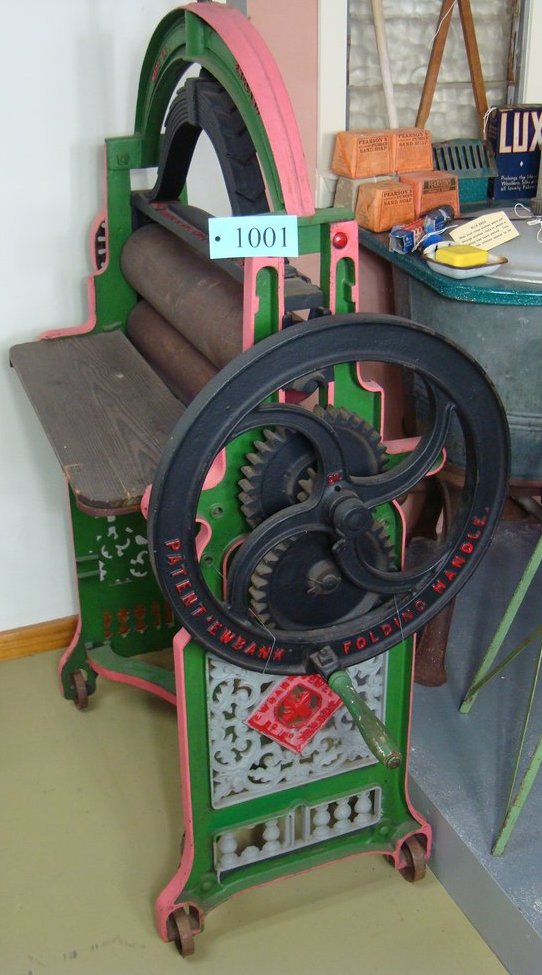
Those great cast-iron mangles were widely used throughout the period 1880 to 1940, as were hand-operated, wooden-framed clothes wringers. An extraordinary offering of patent washing machines were available to anyone of means – some were great tumbling wooden barrels while others followed very closely the familiar principle used in modern electric models.

Monday was the traditional wash day in most households and the whole operation was like a ship in the days of steam and sail. What a scene there was on Mondays in the wash-house: clouds of steam, smells of soap and smoke, white sheets and blue bags. Many older folk will remember itinerants coming round selling clothes props made from thin saplings and even handmade clothes pegs. The clothes horse was an essential item – still to be seen but generally replaced by the tumble dryer.

For kitchen utensils, there were patent egg whisks, lemon squeezers, flour sifters, cork shapers, food choppers and meat mincers, spring balances, jam pans, enamelled colanders, soap savers, preserving jars, knife cleaners, pudding boilers, gem scone pans, waffle irons and a whole range of bins, crocks and tins for flour, bread, sugar, tea, rice and other foodstuffs.

Can openers naturally appeared when cans were eventually made out of reasonably thin plate. The bullshead type is thought to be the earliest and to have been first made in the United States. Curling tongs and goffering irons are two interesting old items. The former were essential at times when curls were fashionable and the latter were used for pressing ruffles in clothes. Corkscrews, bottle openers and penknives capture the imagination of a whole troop of keen collectors. Few now remember that penknives or pocket-knives were once for cutting the pen point of a writing feather or quill.

Match holders and match tidies in cast iron were an interesting household object. Most had a receptacle for the box of matches and a little tray for dead matches.
Mousetraps and rat traps ranged from that basic wooden type still available today, to the most ingenious and one might say, ghoulish devices that could be dreamt up. Fly traps were and still are very useful and effective items for Australian households; and there was the ecologically-sound wire fly swatter of course, which some connoisseurs say is far superior to the plastic variety.

Meat safes and Coolgardie safes were to be found in any house before the ice chest and the refrigerator came along – like the old canvas water bag, they are now relegated to distant and isolated corners or to certain lifestyles quite removed from life in the cities.
However, many items from our parents’ and grand-parents’ and great-grandparents’ times have changed little and remain familiar, others have become collectors’ curiosities to marvel at or simply enjoy as reminders of a different age.
To see these, and many other interesting objects from days gone by, visit the City of Canada Bay Museum on any Wednesday or Saturday between 10:00 am and 4:00 pm. Air-conditioned. Entry Free. Everyone welcome.