
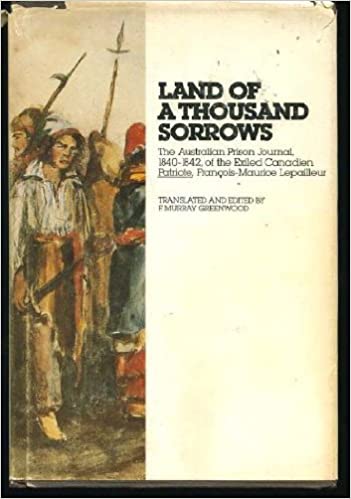
Portion of a diary kept by a French-Canadian exile, François Maurice Lepailleur, whose group had been landed at the original wharf at what is now called Bayview . . .
Wednesday, 11 March 1840. Today we disembarked from the Buffalo to go to work for the government. It was half past nine in the morning when we disembarked and embarked on a middle-sized barge with all our gear and 5 men (guards) and we went to live about 8 miles from the town of Sydney. This place is between Sydney and Parramatta. The people of this area seem to us to be nice. Same food as on the ship, except we have bread and porridge made from maize instead of oats.

Thursday, 12 March 1840. We aren’t doing anything today. In the afternoon they stamped two letters on the front and two letters on the back of our trousers. Those letters are L.B. about 3 inches long. They stand for Longbottom. This stamp is very humiliating for respectable people.
Friday, 13 March 1840. We began work today. We carried stone in 13 wheelbarrows, from 13 laden barges at the wharf. Another group broke the stone into small pieces. We did a good day’s work – the guards were pleased with us.

Saturday, 14 March 1840. We worked only from 6 o’clock to ten o’clock and after that our working day was over. Saturday afternoons are for prisoners to clean up and wash their gear.
Sunday, 15 March 1840. We are beginning the same work as last week. A Major Barney visited us on Tuesday and took a list of all who had professions and trades and all of those who were most respectable. He told us the Governor would visit us on Wednesday to tell us how to behave here. We waited all week but the Governor did not show.
. . . and so the diary goes on. It is from the translation by F. Murray Greenwood of “Land of a Thousand Sorrows” and published by Melbourne Uni.Press, 1980 – the true story of French-Canadian exiles shipped to the Colony under appalling conditions while aboard ship.

THE VILLAGE OF LONGBOTTOM was a small peninsula bounded by Parramatta & Concord Roads and the Parramatta River. The Longbottom Stockade was situated on Parramatta Road, a little to the east of St Luke’s Park. Three small bays which appear on modern maps of the district are named France Bay, Exile Bay and Canada Bay, apparently to commemorate the presence there of the French-Canadian prisoners.
The road on the map, shown as Wharf Road, is now Burwood Road and leads to the point where the barge carrying the prisoners landed. It is now Bayview Park and contains a monument to the French-speaking Canadian exiles



https://vimeo.com/553145841/46dad05fa0