

Forty four years ago, n March 5, 1974, Queen Elizabeth the Second became the first reigning British monarch to set foot on Hospital ground. The “private” visit to Rivendell came after a quiet lunch on board the Captain Phillip, which was intended as a respite from a pressing series of public engagements. The idea was for the Royal party to proceed as far as possible to Parramatta by water, and then transfer to the familiar Phantom V Rolls Royce. Rivendell was convenient, appropriate and picturesque for the operation. Everyone was determined to make the most of it!
Prince Alfred Hospital: It was particularly fitting that the Queen should have trodden Prince Alfred turf, since it was a misadventure during a much earlier royal visit which brought about the Hospital’s existence. In 1868, while attending a public function at Clontarf (of all places) Prince Alfred, Duke of Edinburgh, Queen’s Victoria’s third son, was wounded during an assassination attempt by a crazed Irishman named O’Farrell. This was before the days of Interpol computer checks. Anti-Irish sentiments within the community ensued (this was before the days of Al Grassby).
After the bullet had been successfully removed and the Prince had survived, it was decided at a meeting that a public expression of joy at the Prince’s recovery should be a permanent memorial, in the form of a public hospital.
Having dispensed with the historical aspect, now for the Diana Fisher version.
 The Queen’s visit to Rivendell was timed to the last ten minutes. In retrospect it seemed much shorter! The launch circled the wharf several times because it had arrived early. The Queen and the Duke of Edinburgh stepped ashore into the languid late-summer heat. Following was Lady-in-Waiting, the charming Lady Susan Hussey, wife of Marmaduke Hussey, a London Times executive. The Marchioness of Abergavenny was rostered off.
Perhaps the most nervous spectator so far had been the wife of the launch’s Pilot, who had been perched precariously on rocks, whose camera had jammed, so she thought.
After presentations to the crew, Her Majesty and His Royal Highness proceeded through the renovated boathouse, to meet the Chairman, Mr. Roy Turner, the General Superintendent, Dr. Don Child, and the Director of Rivendell Adolescent Unit, Dr. Marie Bashir.
The Queen was wearing a gold and white figured dress and matching jacket with a gold breton hat with white applique on the crown. She had “sensible” white shoes, the usual “formidable” handbag, and her famous, exquisite complexion.
The crowd that lined the pathway from the gate house to the Main Drive was just right: not too large to block anyone’s view, not too small as to seem anaemic.
One can only relate that If the scenes that attended the Royal Progress up the path are anything to go by, Republicanism here is a dead letter: an elderly woman member of the Concord Historical Society seemed to shed decades as she presented a posy of yellow flowers, which fortuitously matched the royal ensemble.
The Queen’s slow, almost mesmeric nod, beguiling smile and occasional exchange of a few words, usually with either the very old or the very young, continued to work their magic because they are completely natural and patently sincere.
Prince Philip, the royal wisecracker, operates in somewhat different vain: “That thing giving you trouble?” he enquired of a group of nurses wrestling with recalcitrant palm frond.
When the party reached the top of the path, the Queen was presented with the official posy by Jocelyn Morgan, daughter of a Rivendell gardener and then the Duke and she signed the Visitors Books of Rivendell and the Main Hospital.
The quintessential civility surrounding the British monarchy could be caught when the Lady Susan Hussey actually apologised for blocking someone’s view.
Good-byes were said, the couple entered the Phantom V Rolls, at the head of a cavalcade of less distinguished vehicles, departed for the equally less idyllic environs of Parramatta Sports Stadium.
An elderly lady in a wheel-chair related how she had told the Queen about her recent one hundreth birthday. “Did you get my telegram?” the Queen enquired, solicitously.
It was hard to believe that this was the same voice which, every year in the first week of November, at the State Opening of Parliament, woodenly intones the words “My Lords and Commoners, Pray be Seated!”
The visit lasted eight minutes. Everyone present will remember it forever.
RPA Newsletter, Autumn 1986

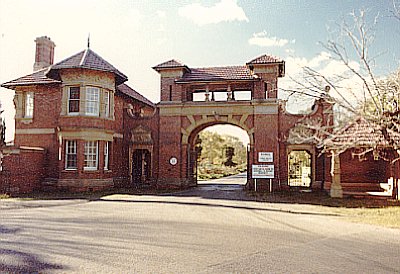


I think there were two visits to Rivendell, 1977 and 1986. The top photo is from 1986 (I was there!), but the black and white photos are from the 70s.
I think there are some inaccuracies with this story.
It was unlikely to be the royal tour of 1974 because:
A. Rivendell didn’t move to Thomas Walker until 1977
B. The 1974 tour was abandoned because of a snap election in the UK – in fact the Queen was appointing Harold Wilson as prime minister on March 5 1974
Was it the 1977 silver jubilee tour?
You are correct. It was the Jubilee tour in 1977.
I gave her flowers officially as she came to Rivendell. I was not born until 1976 so definitely inaccurate information. My mother worked at Rivendell for Dr Marie Bashir at the time. I was probably 10 so it would have been 1986 tour.
My Mum was working as a pharmacist at CRGH at the time & she remembers the visit. Def was 1986!