Shipwrecks of Homebush Bay: How to get there


From Bennelong Parkway

From Homebush Bay Drive, turning into Australia Avenue, passing Bicentennial Park main entrance, turn right at Bennelong Parkway, follow the signs to the Archery Centre, veering right and over a little road bridge, parking is on your left opposite the apartment block on the corner at Wentworth Point.

Cross the road and follow the footpath (to the left of the apartment block), this will lead you to the water’s edge, to your right you will see a white footbridge and the stunning SS Ayrfield floating on the water amongst the mangroves

What makes SS Ayrfield so special amongst the photographers is the east lying position of the floating forest shipwreck, making it a stunning rustic subject matter when set amongst a sunrise or sunset backdrop.

From Bicentennial Park

From Homebush Bay Drive, turning into Australia Avenue, turn right into the main entrance of Bicentennial Park, follow the road all the way to the last parking lot P10f.   The parking area is directly opposite the Badu Mangrove boardwalk.

This is an excellent scenic 1.3km walking track, which first takes you through the mangrove boardwalk before joining up with the cycleway/footpath, turn left and follow the path all the way to the shipwreck lookout. On your left you will pass the salt marsh, then the stunning waterbird refuge filled with birdlife. You will soon spot the first shipwreck SS Heroic on your right through the mangroves in the water.

Track to the Shipwreck Platform

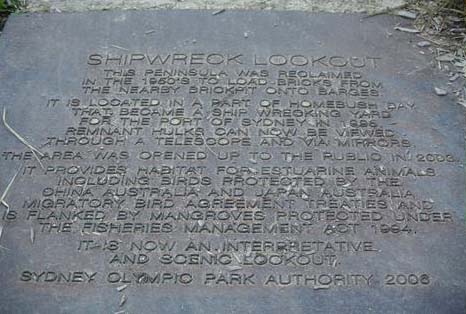
Towards the end of the track, you will come to a small sandy/pebbly path with a metal plaque on the ground titled “Ship Wreck Lookout” with a brief history. To your right you will find HMAS Karangi. By the water’s edge you will find the old wooden ship-breaking ramp and crane and a telescope to view SS Ayrfield and SS Mortlake Bank.

http://www.weekendnotes.com/shipwrecks-homebush-bay/


Similar Posts

  • The Colour Cure

    Under the heading “Occupying “canary” room.  Nerve Cases are Soothed” the following article was published on 24 March 1919. In the new Red Cross convalescent Docks, Sydney, NSW, the colour cure idea has been introduced by Miss Eadith Walker. This is an experiment in such treatment in Australia, and R. R. de Mestre, a young…

  • Needlework Tool Collectors

    The Needlework Tool Collectors Society of Australia (NTCSA) began in 1987 in Melbourne, growing from the enthusiasm and interests of two sisters, Katrina and Jenny, who gathered together their friends and fellow collectors to form the Society.   When travelling interstate, they would arrange to have afternoon tea with other collectors, inviting them to join.  As numbers grew, it became…

  • Buying a Car – a Retrospect

    Nowadays there’s no mystery about motor cars. They infest every road and are driven with varying degrees of competence by teenagers and grandmothers. When it comes to buying a car, schoolboys can usually give their fathers all the performance figures of the leading makes but back at the dawn of motoring things were very different indeed. Between fifty and sixty years ago the tempo of…

  • Parramatta River

    The River as a Rowing Course Between 1830 and 1880, rowing was the most popular sport in Sydney.  This popularity probably had a lot to do with the success that Sydney rowers had achieved in World Championship events.  The first Australian to win a World Championship was Ted Trickett, who, on 27 June 1876, beat…

  • Coming Ready or Not

    Japanese Midget Submarines enter Sydney Harbour. The boom safety net protection across Sydney Harbour was designed in January of 1942 and its construction began that month.  It was located at the narrowest point of the inner harbour entrance, between George’s Head on Middle Harbour, and Green Point on Inner South Head.  This protective net was…

  • From Our Collection

    Singer Miniature Toy Sewing Machine – Model 20-1 When the Singer 20 Toy Sewing Machine, manufactured in the U.S.A., was introduced in 1910 it was in a league of its own.  Although the Singer 20 was of a simple chain stitch design requiring just 40 components, it was very well engineered with a cast iron…

Add your first comment to this post