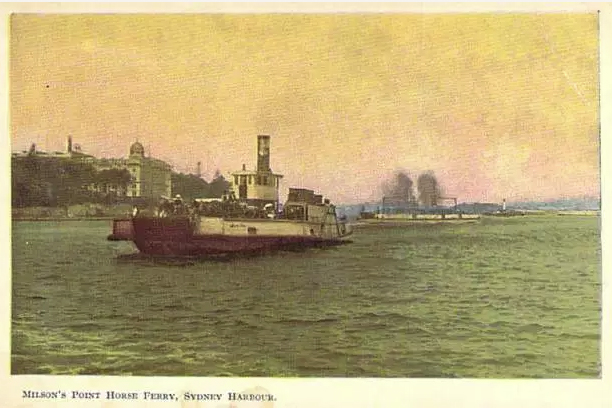
Milsons Point and The Horse Ferry


The image above is a stunning snapshot of a piece of Sydney history that many are not familiar with.

Today, we are all familiar with the Harbour Bridge, and take for granted the fact that we can easily cross the harbour by car, train, bike or bus. Many of us are familiar too with the history of the stunning bridge itself, yet we little think of what came before and how people, let alone vehicles, crossed the harbour before the bridge was built.

Before the Harbour Bridge, there were only two ways for people to move vehicles like horses and carts, or later, cars, from one side of the harbour to the other. The first was to travel to Bedlam Point and use the punt which crossed the relatively small distance of water. This was a little inconvenient for many, as it involved travelling quite a distance. The other option was to use one of the horse ferries operating on the harbour itself, like the one shown in this postcard.

When we think of a vehicular ferry today, we tend to think of cables pulling the ferry across the span of water. Yet this was completely impractical for the harbour itself, as the span of water was much too great and there were many ships which needed to move beyond the ferry point. A cable would have prevented this. Instead, steam ferries were used, transporting everything from passengers to horses, carts and produce between Dawes Point, Blues Point and Bennelong Point.

There was, of course, a fee involved and each different type of passenger and vehicle was charged differently. The fees were so specific that there was even one for a ‘Chinaman with two baskets’.

When the Harbour Bridge was opened in 1932 there was no longer any need for the ferries and the wharves were demolished and the boats put to other use.

Ref:  https://australiaspastpresent.com/   If you are interested in old photographs and old history this would be a good site to visit.


Similar Posts

  • From Our Collection

    The Darning Mushroom This darning tool was an essential item in 19th and early 20th century household as self-reliant women often had to make and repair all their clothing. Darning would have been considered a necessary skill for girls and young women, part of their education as future wives and mothers. The darning mushroom would…

  • Vale Alan Wright

    On Thursday, October 13, 2022, the City of Canada Bay Heritage Society lost one of its most enduring, influential, universally friendly and hardworking members when Alan Wright died peacefully in Concord Hospital.  Alan was one of our society’s last three active founding members and will be sadly missed.  For many years he was our President….

  • Museum Closed

    With the potential for a further extension of the lockdown due to Covid we do not know when the museum will re-open. As a result, we have cancelled our advertised October speaker – but we will certainly invite him back once things begin to open up again. Unfortunately, we had to cancel our July Rivendell…

  • I Grew up in Concord

    Extract from my autobiography (an unfinished project) by Peter Bryant In the 1920s, some of Concord’s large estates like “Yaralla” on the Parramatta River, were subdivided and made available for housing. By 1926, the year my mother and father married, new streets and avenues had been laid out.  They ran down to the edge of…

  • Boxing in Concord

    Permission Refused The following article was published in the Sydney Morning Herald on Monday, 20 February, 1922. The introduction of boxing into the district is objected to by the Central Concord Progress Association which has written to the local council protesting against the granting of an application for permission to hold a contest in a…

Add your first comment to this post