
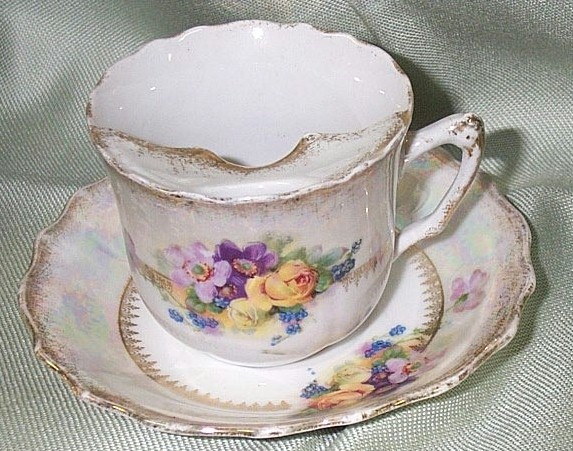
The Moustach Cup
The moustache cup is an unusual drinking vessel, uniquely gender-specific. that contains a semi-circular edge around its rim. This ledge has a small opening that allows liquids to pass through and functions as a guard to keep moustaches dry. British potter Harvey Adams, born in Stoke-on-Trent, Staffordshire, is generally considered to be the inventor of the moustache cup in the 1860s.
During the Victorian era, moustaches were very fashionable and, to maintain their appearance, were usually stiffened with wax and dye in order to keep their shape. Unfortunately, drinking warm drinks posed a problem for the moustachioed Victorian man. Steam emanating from the warm drink would not only melt the moustache’s wax, which could drip into the cup, but sipping coffee or hot tea would often lead to stained moustaches

In order to solve this problem, Adams created a ledge that went across the cup that would prevent a well-groomed moustache from getting stained or wet. The moustache cup was very successful in the late-nineteenth century and quickly spread from England to America.
Moustaches flourished throughout the Victorian era. In fact, from 1860 to 1916, the British military actually required all of its soldiers to sport a moustache for the authority it imparted to the moustachioed man.
But the golden age of moustaches, and moustache cups, came to a closing during the First World War. It ended, as it had begun, in the British army; the former stipulation was scrapped, as men struggled to maintain good grooming in the trenches. More importantly, a hairy face made it near-impossible to get a decent seal on a gas mask. Industry shifted to serving the troops and the war effort, and the moustache cup fell from favour and then from sight.
John Lennon drank his tea from a moustache cup during the recording of The Beatles’ album, “Sgt. Pepper’s Lonely Hearts Club Band”.


