From Our Collection


A Naval Jacket (c late 19th Century)

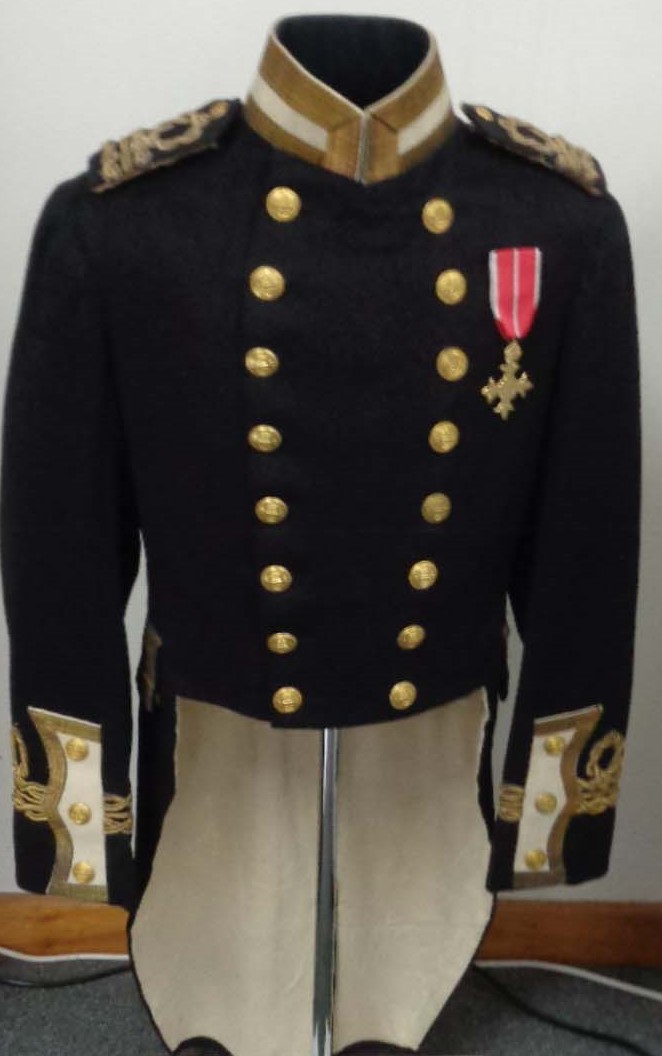
A dark navy blue wool serge, double-breasted naval “under dress” uniform with gold braid trim and 8 rows of brass buttons. It was worn by Lieutenant-Commander Rupert Oswald Jones, OBE, RNR (Rd.).

The style is traditional to the late 19th Century Royal Navy uniforms but with a twisted gold braid around the cuffs, characteristic of the Navy Reserve Uniforms of the same period.

Rupert Jones was born in London in 1881. At the age of 29 he gained his Certificate of Competency as Second Mate for Foreign Going Vessels and four years later an upgraded Certificate as First Mate for ships plying international waters.

In 1908 he secured a position as an officer aboard the merchant ship S.S. Iconic, which sailed out of London.

He later settled in Newcastle, NSW where he was attached to the Royal Navy Reserve.  There he met Margaret Johnson of Stockton and they married in 1913.

At the outbreak of war in 1914 he was appointed to take charge of the Port Suez Convoy Office, responsible for the control of shipping through the canal and port areas.

It was for “excellent service” in this role that he was awarded an Order of the British Empire in July 1919.

Jones returned to Newcastle in 1920. However, about 1930, he and his wife moved to their newly purchased home on La Mascotte Avenue, Concord.

In 1942 Commander Jones was appointed for temporary service in the Royal Australian Naval Reserve stationed at Rushcutters Bay.

Jones died at his home in Concord in August 1959, survived by his wife and daughter.

This jacket was donated by his daughter, Sylvia Garrick.

This WWI Naval Uniform was recently restored through a grant from the Australian National Maritime Museum, Sydney and is now on display at our museum at 1 Bent Street, Concord.

 

Similar Posts

  • Sir Arthur Conan Doyle

    Doyle’s adventures in the Antipodes Arthur Conan Doyle had trained and practised as a doctor until the success of his Sherlock Holmes stories allowed him to give up medicine and become a full-time writer. His autobiography, Memories and Adventures, reveals a more than passing interest in the supernatural as early as the 1880s. In his account of…

  • Kids Say the Darndest Things

    Teacher:  How old is your father?     Kid:  He is 6 years.Teacher:  What?  How is this possible.   Kid:  He became father only when I was born. Teacher:  Maria, go to the map and find North America.     Maria:  Here it is.Teacher:  Correct.  Now, class, who discovered America?   Class:  Maria. Teacher:  Glenn, how do you spell ‘crocodile’?     Glenn: …

  • From our Collection

    Commode A commode is often assumed to be a euphemism for a toilet.  Originally it referred to a chest of drawers or cabinet used for storing personal items. The name derives from the French word meaning convenience or suitable. French furniture makers in the 18th Century fashioned highly decorated cabinets topped with marble. These were…

  • Drummoyne Remembers

    If you look at enough Great War memorials, it becomes apparent there is little uniformity in the way they are presented. Some list names in alphabetical order, others separate these by rank or in the order individuals enlisted. Before 1927 there was no national agency to collect the names of those who served or died…

  • April Fools’ Day

    Also known as All Fools’ Day, it is celebrated annually on the first day of April. It is a time for the traditional playing of pranks upon unsuspecting people . . . the victim of such a prank being called an April Fool. The origins of this custom are somewhat uncertain, but may have initially…

  • Eugene D. Nicolle, Inventor

    After the 1848 revolution, Eugène Dominique Nicolle (1823 – 1909) came to Australia to pursue his career as an engineer. Arriving in Sydney in 1853 with his first wife, Nicolle registered his initial patent for an ice-making machine jointly with Richard Dawson in 1861. Nicolle eventually secured the financial backing of Thomas Sutcliffe Mort for his experiments, which…

Add your first comment to this post