
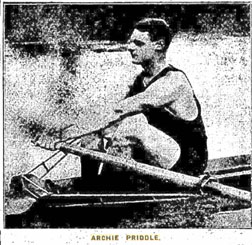
Archie Priddle had already achieved national prominence when he enlisted in the A.I.F. in January 1915. Tall, strikingly handsome with fair hair and blue eyes, Priddle competed in a series of swimming and sculling races against celebrated New Zealand champion, Paddy Hannan. Their contests excited national attention with hundreds of pounds being offered in prize money and large sums wagered on the outcome.
 As NSW amateur champion, Priddle challenged the professionals in 1914 to win the title of Australian Sculling Champion. His father George was a previous Australian champion and competed against the likes of the great William Beach. Beach won a remarkable six World Sculling Championships before retiring undefeated in 1887. An obelisk on the foreshore of Cabarita Park, close to where Beach raced, commemorates his achievements.
George Priddle was also licensee of the Palace Hotel, Mortlake, situated at the end of Tennyson Road (Burwood Road) near the terminus of the Enfield-Cabarita-Mortlake tramway. This impressive three-storey hotel became a favourite with those attending rowing regattas. Ideally situated close to the water it commanded fine views of the district as well as the river in both directions. George Priddle purchased the hotel in 1913 and sold it on his retirement in 1922. It was demolished several years later and a second Palace Hotel was built closer to the gas works.
Archie Priddle was born in Raymond Terrace in February 1890. His father was manager of a hotel in that town before moving to Sydney, where he bought the Palace Hotel. Archie followed his parents to Concord and became a motor vehicle agent, importing cars from overseas. On his enlistment application Archie listed his father as next of kin and gave his parents’ home, “Mornington” in Wellbank Street, Concord, as their address. Archie’s marriage to Marjorie May Parrington a month later meant this was soon amended to Wetherill Street, Croydon.
On completion of his training Priddle was assigned to the 25th Battery 7th Field Artillery Brigade with the rank of Gunner (Private). A natural leader, he was promoted to Lance Corporal within three months and the following year to Sergeant. In 1917 he was commissioned as a 2nd Lieutenant and sent to training school in Britain where he studied aeronautics and trained to become a pilot. Priddle joined the newly formed Australian Flying Corps, a forerunner of the RAAF. In August 1919 he was transferred to the British Army where he served as a pilot on a three-month secondment before returning to Australia in November 1919.
Electoral records show that after the war Archie Priddle became a building contractor. He and his wife moved to Ocean Street, Narrabeen, where they continued to live until Archie’s passing in October 1954. George and Maria Priddle remained at Wellbank Street until George died in 1929.
Andrew West


